Showing posts with label Automotive. Show all posts

Saturday, 9 July 2011

Interior light extender


1. Mount components to the PCB from the PLAIN SIDE.  Polarity must be observed for DI, (Power Diode) and for CI (Electrolytic Capacitor).
(i) DI - Band on Diode is at K (-ve) end
(ii) CI - Arrow on Body of Capacitor points down the negative leg.
Push the component legs through, nip off 1-2mm clear of the bus-bars and bend leg's in opposite directions. This will hold the components in place.
2. TI (BC558) should be mounted with the flat section in the direction shown.
3. T2 can be mounted as follows:
(1)  Turn the end of a piece of link wire to a ring and solder together. This ring is attached to a hole in the transistor body by a 1/2 x 1/8" Metal thread screw. The link wire is cut and soldered at B1 - B6.
(2) The legs on the transistor are too large to fit into the holes in the Veroboard so solder short lengths of link wire to the transistor legs and solder these to the PCB.
4. Solder electrical wire from Kit to 12V + and 12V - positions.
5. To wire to automobile circuit, the following procedure is recommended.
(a) Locate the wire from the Interior Bulb to the switch activiated by the car door.
(b) Determine that the car has a Positive Earth or Negative Earth Wiring system by checking the battery. (Most cars use negative earth).
(c) For Negative Earth System join the 12V +ve wire from your project to the wire from bulb to switch using the wire-tap from the Kit. For Positive Earth system join 12V -ve wire instead.

(d) Ensure that the cover on the wire-tap is folded into place so that no bare metal is exposed.
(e) Join the 12V -ve wire from your project to a suitable earth point on the car body. (For Positive Earth system read 12V +ve).
NOTE: Do not cut existing wiring to the interior light just join the project in parallel with the switch.
(f) Test the unit for correct function.
TROUBLE SHOOTING
(i)  Check for dry joints, joints not soldered at all, or solder bridging PCB tracks.
(ii)  Check polarity of D1 (Diode) C1 (Electrolytic Capacitor) T1 BC558 PNP Transistor and T2 2N3055 NPN Transistor must be mounted as shown in diagram.
(iii) Check locations of all components.
Technology Notes
All modern cars are fitted with door-switch operated courtesy lights. Useful devices, but not quite as useful as they might be because they are so arranged that the light is extinguished as soon as you close the door - just when you need light to find the ignition switch. do up your seat belt etc. How much better if the internal light stayed on for a few seconds after the door is closed.  This little project does just that. It provides a four-second delay (approx) after which the interior light slowly dims - being finally extinguished after 10 or 12 seconds.  The unit is very simple to construct and once tested and properly insulated it may be wired across one of the car door switches.  In operation, after a short delay the lights will gradually dim until they are completely extinguished. There is no battery drain in the off-state as the unit only operates during the delay period after the door is closed.
Most car door switches am simply simglec-pole switches. with one side earthed.  When the door is opened the switch earths the other line thus completing the Light circuit.
In a car whem the negative terminal of the battery is connected to the chassis the nerative wire of the unit (emitter of Q2) is connected to the chassis and the positive wire (case of 2N3055) Is connected to the wire going to the switch.  In. a car having a positive earth system this connection sequence is reversed.
When the switch closwe (door open) C1 is discharged via DI to zero rolts and when the switch opens, C1 charges up via R1 and R2. Transistors QI and Q2 are connected as an emitter follower (Q2 just buffers Q1) therefore the yoltage across Q2 increases slowly as C1 charges.  Hence Q2 acts Like a low resistance in pars1lel with the switch - keeping the lights on.
The value of C1 is chosen such that a useful light level is obtained for about four seconds, thereafter the light decreases until in about 10 seconds it is out completely.  With different transistor gains and with variation to current drain due to a particular type of car the timing may be simply adjusted by selecting C1.


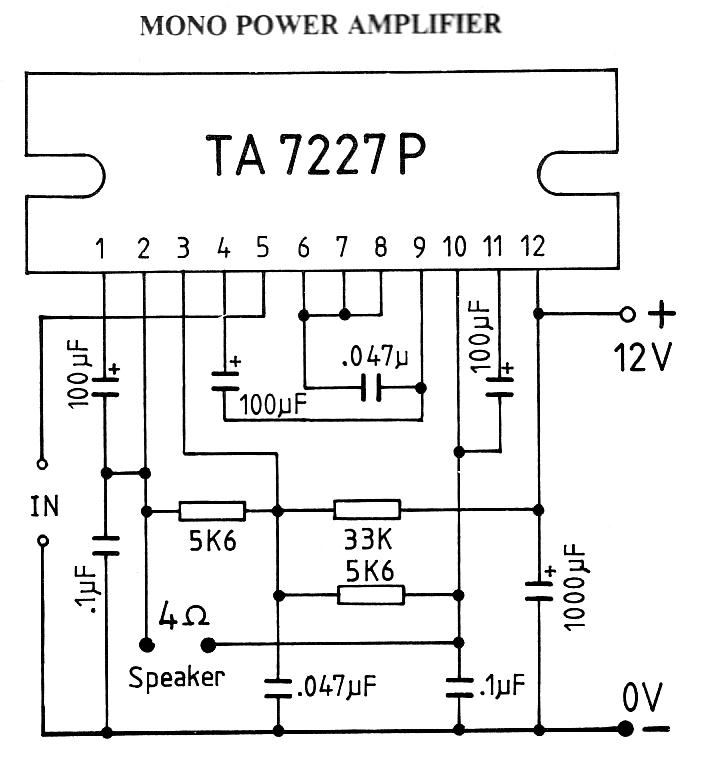
15W mono car amplifier using TA7227P


source

Tuesday, 5 July 2011

Car Battery Charger circuit fast

This charger will quickly and easily charge most any lead acid battery. The charger delivers full current until the current drawn by the battery falls to 150 mA. At this time, a lower voltage is applied to finish off and keep from over charging. When the battery is fully charged, the circuit switches off and lights a LED, telling you that the cycle has finished.
Parts


R1 1 500 Ohm 1/4 W Resistor
R2 1 3K 1/4 W Resistor
R3 1 1K 1/4 W Resistor
R4 1 15 Ohm 1/4 W Resistor
R5 1 230 Ohm 1/4 W Resistor
R6 1 15K 1/4 W Resistor
R7 1 0.2 Ohm 10 W Resistor
C1 1 0.1uF 25V Ceramic Capacitor
C2 1 1uF 25V Electrolytic Capacitor
C3 1 1000pF 25V Ceramic Capacitor
D1 1 1N457 Diode
Q1 1 2N2905 PNP Transistor
U1 1 LM350 Regulator
U2 1 LM301A Op Amp
S1 1 Normally Open Push Button Switch
MISC 1 Wire, Board, Heatsink For U1, Case, Binding Posts or Alligator Clips For Output


Notes
  1. The circuit was meant to be powered by a power supply, which is why there is no transformer, rectifier, or filter capacitors on the schematic. There is no reason why you cannot add these.
  2. A heatsink will be needed for U1.
  3. To use the circuit, hook it up to a power supply/plug it in. Then, connect the battery to be charged to the output terminals. All you have to do now is push S1 (the "Start" switch), and wait for the circuit to finish.
  4. If you want to use the charger without having to provide an external power supply, use the following circuit.
2nd circuit (power supply)
Parts

C1 1 6800uF 25V Electrolytic Capcitor
T1 1 3A 15V Transformer
BR1 1 5A 50V Bridge Rectifier 10A 50V Bridge Rectifier
S1 1 5A SPST Switch
F1 1 4A 250V Fuse

  1. The first time you use the circuit, you should check up on it every once and a while to make sure that it is working properly and the battery is not being over charged.

Thursday, 16 June 2011

Car Battery Charger


  1. This charger will quickly and easily charge most any lead acid battery. The charger delivers full current until the current drawn by the battery falls to 150 mA. At this time, a lower voltage is applied to finish off and keep from over charging. When the battery is fully charged, the circuit switches off and lights a LED, telling you that the cycle has finished.

Parts
R1                         500ohm
R2                         3k
R3                         1k
R4                         15ohm
R5                         230ohm
R6                         15k
R7                         0.2ohm
C1                         0.1uF 25v ceramic capacitor
C2                         1uF 25v electrolytic capacitor
C3                         1000pF 25v ceramic capacitor
D1                         1N457 diode
Q1                          2N2905 pnp transistor
U1                          LM350 regulator
U2                          LM301A opamp
S1                          normally open push button switch
MICS                     wire,board,heatsink for u1,case,binding posts or alligator clips for output


Note 


  1. The circuit was meant to be powered by a power supply, which is why there is no transformer, rectifier, or filter capacitors on the schematic. There is no reason why you cannot add these.
  2. A heatsink will be needed for U1.
  3. To use the circuit, hook it up to a power supply/plug it in. Then, connect the battery to be charged to the output terminals. All you have to do now is push S1 (the "Start" switch), and wait for the circuit to finish.
  4. If you want to use the charger without having to provide an external power supply, use the following circuit.
Parts
C1             6800uF 25v electrolytic capacitor
T1              3A 15v transformer
BR1           5A 50v bridge rectifier
S1              5A SPST switch
F1              4A 250v fuse

The first time you use the circuit, you should check up on it every once and a while to make sure that it is working properly and the battery is not being over charged. 


Wednesday, 15 June 2011

Car Alarm Arming Horn Beep Canceller

It's a great convenience that most modern cars come with a built in alarm, however it is nothing but noise pollution that the horn sounds when the alarm is armed. Disconnecting the alarm system from the horn relay will eliminate this, but prevent the horn from sounding in the even of an actual alarm. This circuit serves to silence the arming beep yet maintain the alarm by introducing a small delay into the signal. It sits between the alarm and horn relay. The alarm must provide a constant horn signal for at least 3 seconds before the horn relay is activated. That way the quick "beep" will never activate the horn relay, while the constant alarm signal will.
Parts
C1               0.01uF ceramic disc capacitor
C2               100uF  35v electrolytic capacitor
R1                1k
R2                10k
R3                15k
R4                470ohm
D1,3,4         3(1N4004)rectifier diode
D2                red led
U1                555 timer ic
K1                spst 12v automotive relay


Tuesday, 14 June 2011

Portable CD Player Adapter For Car

Whenever I'm in the car listening to my favourite CD, it always happens; my batteries go dead. To solve that problem, I built this extremely simple regulator circuit. It steps down the 12V from the lighter socket to 9V which is used by the CD player. Different CD players (I have a Sony Discman) may require different voltages, so just use the correct regulator. All the 78xx series regulators have the same pin out, so the circuit is universal.
Parts
Electrolytic capacitor
C1     1000uF 25 v
C2     10uF     25 v
C3     1uF       15 v
C4      0.1uF   15 v
IC
U1     7809
Mics  
Cigarette lighter plug,plug for cd player